


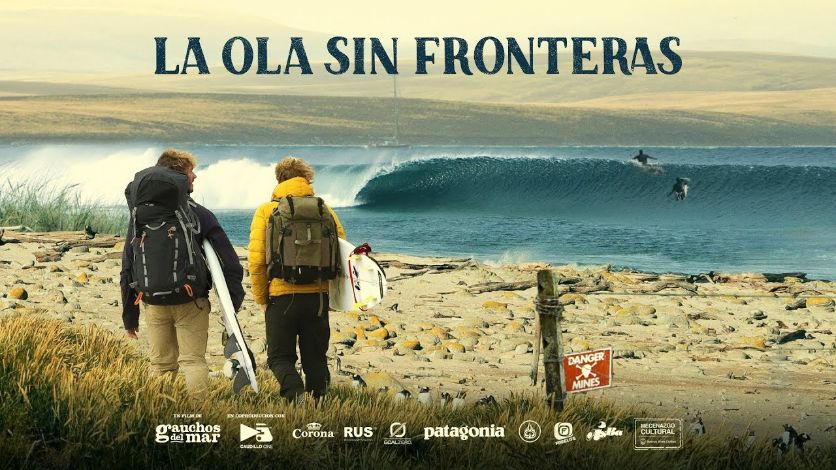
Surf movie: La Ola Sin Fronteras (2019)
Transcending Waves
As surfers, we know that it doesn’t matter where we are from, which language we speak, or how we’re spending our days when we’re not in the water. The love of the ocean and the waves renders everything else meaningless. This is what La Ola Sin Fronteras is all about.
The movie documents two brothers who are exploring a remote part of this world in search of good waves. Political circumstances make it at times difficult but aren’t holding them back. Despite several obstacles in their way they make new friends, score big waves that they only share with penguins and dolphins, and explore stunning landscapes.
La Ola Sin Fronteras is not the typical surf movie, but a documentary about Joaquin and Julian Azulay – two Argentinian brothers who explore the Falkland Islands, a less-known archipelago of more than 700 islands, by overcoming political barriers to surf the best waves.
The political background
To get this out of the way immediately: The movie La Ola Sin Fronteras is not a political statement in any way. It is a surf adventure that meets some limitations that are of a political nature.
What makes this expedition difficult for Julian and Joaquin is the fact that they’re Argentinian. Every attempt to approach the Falkland Islands is seen as a political interference. This dates back to the year 1982 when Argentina and the United Kingdom fought a war over the sovereignty of the Falkland Islands. The movie starts with on-screen text explaining this historical background as it is important to understand why it was difficult for the two brothers to travel to the islands. Even though they were born after the war and almost 40 years have passed since it is still a delicate subject with borders that exist more in people’s minds than on a map.
“[…] Y Argentina perdió la guerra y, bueno, desde entonces están las islas bajo la soberanía de Gran Bretana. Pero, hay un conflicto en la sociedad latente aká. Entonces es un tema muy delicado en nuestra sociedad, el tema de las islas y para allá también. Genera muchas inquietudes, de manera de como nos iban a recibir, como nos iban a tartar. Uno escucha los peores de las cosas. No? Nos dimos cuenta de yendo con respeto recibimos lo mismo. Y poco a poco, poniendo generar una relación de más cercanía y ideal. Lo que querríamos generar que es un poco más ideal entre las Islas y Argentina. Y nuestro medio como fue el medio de otras personas el rugby y otro fue la natación y nuestro es el surf.”
(English translation: […] And Argentina lost that war. Since then, the islands belong to Great Britain. But there is an underlying conflict in society. It is therefore a very delicate subject in our society, the subject of the islands here and there. It caused many worries in that sense that we didn’t know how they would welcome us, how they would treat us. One hears the worst stories, right? We noticed that if we approach them with respect, we receive the same. Little by little, we could create closer relations. We want this to be a bit more ideal between the islands and Argentina. And our medium such as others have used rugby or swimming, is surfing.”) – Julian Azulay in an interview with Sancho Rodriguez, https://lockdownsurffilmfestival.com/, 12/04/2020
It’s all about the waves
Before they took off to the Falkland Islands, Joaquin, and Julian Azulay were in touch with two brothers who lived on the islands and were the only surfers there. They connected via their common passion for the water sport. As soon as they heard though, that Julian and Joaquin were from Argentina, they stopped talking to them. The movie shows the exchange of those messages right at the beginning. They did not want to get involved in any political matters. Despite this drawback, the two brothers still decided to go to the Falkland Islands. They were hoping to speak to the local surfers in person and break down barriers via surfing. Even though they did not know where they lived exactly, they were sure to meet them in the water.
Exploring the Falkland Islands
Joaquin and Julian spent in total 50 days on the Falkland Islands and explored more than any local going around on foot, in a 4×4, on planes, and a sailing boat. They meet local farmers and learn about the life on the islands that is defined by agriculture and the scars that the war has left.
The movie is filled with stunning landscapes, wide green spaces, and rough coastlines. You can see the two brothers in difficult climate conditions in remote areas and you can see them surfing perfect barrels in ice-cold water. There are no other surfers, only different species of penguins, dolphins, whales, and birds. The video footage that shows how humans and animals share the perfect waves is impressive.
If you see those images, you might think that it was easy for them to just walk around with the camera and record these once-in-a-lifetime moments, but it wasn’t. They needed special permits to ensure they wouldn’t do anything of a political nature.
Obstacles in the way
Apart from politics, they encountered three other circumstances that made it difficult to reach surf spots:
- Rare species and environment
- Minefields that are still highly explosive
- Privately owned land
Some parts of the Falkland Islands are protected in nature, especially during the breeding season of the penguins, and can’t be accessed. The two brothers respected that and showed it in the movie La Ola Sin Fronteras.
The scars that the war has left are still very visible. Certain parts of the islands cannot be accessed because of landmines. In the movie, they speak to people whose job it is to remove those mines, but it’s not easy. They also visit a cemetery and some places of commemoration.
Almost all land on the islands is privately owned and it is not easy to get in touch with people. Everything required a permit.
The human connection
As soon as the locals noticed that they were doing things with respect and were truly interested in anything but politics, they received a very warm welcome. They had help in finding places to stay, camped on farms, and were shown how to get safely to the coast and the waves. They even got interviews that can be seen in the movie. The movie has an educational character.
The movie makes it very obvious that it is not about politics, but about human connection. The hug with Sonia, one of their local hosts, becomes as emblematic as the encounter with the two local surfers in the waves. They achieved the longed-for unity through sport, through their love for surfing.
“If we put issues on a human level, we are all the same and have no differences. The differences are social constructs…” (Gauchos Del Mar)
About the producers
Joaquin and Julian Azulay, the Gauchos Del Mar, are two brothers from Buenos Aires. Their first big project was the realisation of their childhood dream of traveling from California back to Argentina. They had no plans to make movies, but the footage of their first big trip that was recorded on a smartphone turned into a movie project by coincidence. Since then, they have documented all their travels, expeditions, and surf adventures in films.
In their second movie Tierra de Patagones, they explored the Argentinian coastline on foot with a surfboard tied to their backs.
La Ola Sin Fronteras is their 4th surf adventure movie after Peninsula Mitre. The next one will be documenting their travels across the African continent.
All of their movies have two things in common: they’re surf adventures in an under-explored part of the world and there’s always a secondary message such as the Falklands conflict in La Ola Sin Fronteras. It’s not just about surfing.


