Funchal
Visiting Madeira’s capital
The island of Madeira was discovered in 1419 as an inhabited island covered in forests. The first capital was Machico on the Eastern coast and the Portuguese settled from there.
The first settlement in Funchal was in 1424. The name originates in the Portuguese word for Fennel which must have been there in abundance. The sugar cane that grows in Madeira in abundance turned the city into the most important industrial centre on the island in the second half of the 15th century. The flag of Funchal and the coat of arms of the city are dedicated to the sugar cane and the wine that made the island rich.
Charlie had booked a walking tour of the old town of Funchal for € 13 with the university of Madeira. This tour is run by students and all proceeds help fund the university. The guide that day was Hannah who volunteered for the university and was from Germany.


The Jesuits in Madeira
The tour started at the former Jesuit College in the old town of Funchal. It was originally built in 1569 when King Sebastian of Portugal sent the Jesuits to Madeira to protect and develop the island. Due to the trade with sugar and wine, Madeira was a rich island and often threatened by privateers that the French king had sent. Even the Portuguese army wasn’t loyal to the crown and rather robbed the island than protected it. The Jesuits were trusted by the king and started a settlement with a school. It was a school for boys until the Jesuits left the island in 1760. Next door is the Jesuit church which was built in 1620 and is very rich in detail. The interior shows the traditional Portuguese tiles and plenty of ornaments. The Jesuit church has a tower from which you can look over the city and it costs €1. The church is facing today’s town square “Praca do Municipio” and the city hall.


The city hall was originally a residential building which is still recognizable in the architecture. The windows on the ground floor are quite small because those rooms were used for storage, the second floor was used as a workspace with medium-sized windows and the top floor was where people lived, and the windows are the tallest.
Historic traces
You will also see lots of buildings in the old town that have a tower that also dates back to the times of the merchants. They used them to see the boats coming to the harbour and to know when to leave the house. The higher the tower was, the quicker they would see them and the earlier they could be there to receive new goods.
With the first settlement in the 15th century, Funchal is quite young for a European city. Yet, there are some elements in the architecture that tell a story. If you look up whilst walking through the streets, you will notice that the houses in Funchal have different layers of tiles on the roof. They used to be a symbol of wealth in the past. The merchants had two rows of tiles, the nobility had three.
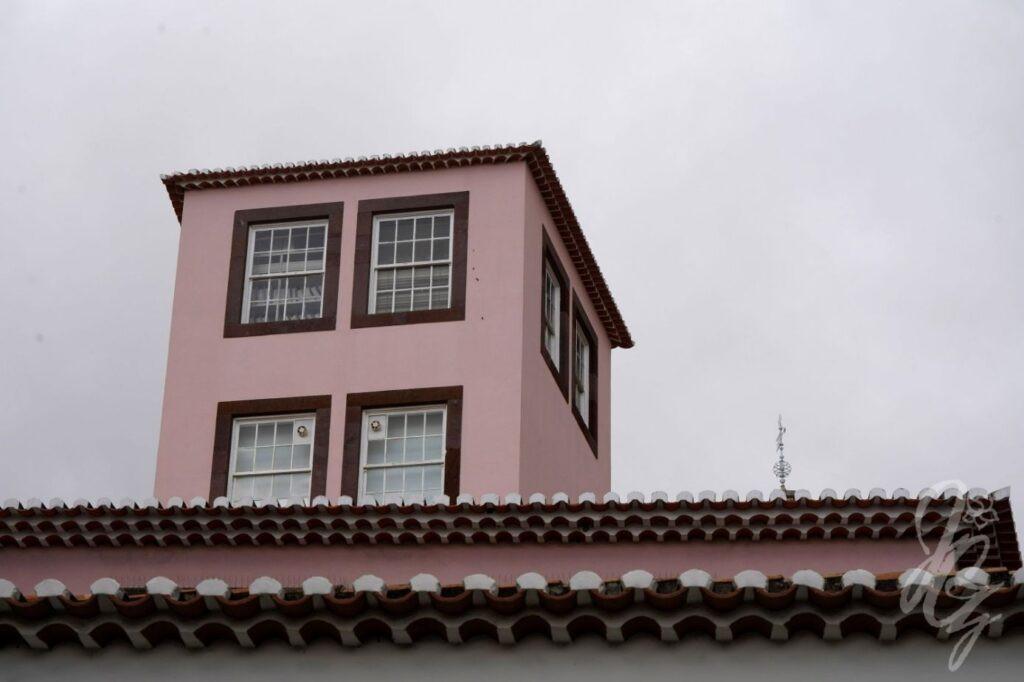
House in Funchal with multiple layers of tiles and a tower
Funchal’s Cathedral
You could almost miss it as you walk past: the Cathedral of Funchal was built between 1507 and 1550 and doesn’t look anything special from the outside. It also is relatively small and almost disappears in between the other buildings along the main road in Funchal. This is exactly the reason why King Manoel I. fired the original architect half-way through the job. He wanted a more impressive cathedral. If you go inside, it does indeed look impressive because of the Arabic-inspired wooden ceiling with geometric patterns. The Arabs were never in Madeira but the architecture on the Iberian Peninsula was heavily influenced by the Moors and so was King Manoel. Charlie saw similar elements of the Manoelian architecture in Belem.

The cathedral in Funchal
A whole new look for the roads leading to the seafront
The closer you get to the harbour in Funchal, the more modern the houses appear. The roads leading up from the port used to be a rough area back in the day and have been renovated in the past century to make them more attractive. The street Rua Dr. Fernão de Ornelas is today one of the main shopping areas and was completely renovated in the 1940s. It shows different styles of architecture, amongst them the German Bauhaus style and the French Art Deco.
The Rua de Santa Maria underwent an artistic project around the year 2000. Artists were invited to paint on the doors. The trick worked, the street is today a popular tourist destination in Funchal, and you’ll find lots of restaurants there. If you want to admire the artwork on the doors, it is best to get there early in the day before the restaurants open.


Painted doors in Rua de Santa Maria in Funchal
Cable Car and Monte in Funchal
When you’re in Rua de Santa Maria admiring artistic doors, you will also see the cable cars in between the houses. The station for the “Teleferico” is just around the corner from there. You can’t miss it. Just outside the station are two boats that have been put into glass houses as if this was a museum. Those are the two remaining boats from the times when Madeira didn’t have an airport. Airplanes would land at sea and the boats brought tourists to the coast.
Going up to Monte by cable car is one of the must-dos in Funchal. You wouldn’t want to miss that view over the city and the coastline, and even some private gardens and terraces. It takes 15 to 20 minutes to get up to Monte where you can visit the Tropical Garden. You can also take another cable car that brings you to the Botanical Garden. You can buy tickets for the cable car and the Botanical Garden directly at the station for the “Teleferico”.
Prices are as follows (as of December 2022):
| Ticket Type | One-Way | Round Trip |
|---|---|---|
| Adult | € 12.50 | € 18.00 |
| Children (7-14 years) | € 6.50 | € 9.00 |
| Children (under 7) | Free | Free |


Views from the cable car in Funchal
If you’d like to see the Tropical Garden you can buy the ticket at the entrance and you will see it when you get off the cable car at the upper end at Monte. The Tropical Garden is inspired by different cultures about which you can learn whilst walking through the garden. You can see the garden in one hour, but you could also easily spend a whole day there. The ticket price is €12.50 per person and free for children under the age of 15.


The Tropical Garden in Funchal
If you want to get back to the seafront, you could take the cable car back down or alternatively take the historical Toboggan, a wicker basket sledge. It might sound scary but the men who “drive” the Toboggans are experienced and know how to get around the corners in the narrow streets and acknowledge traffic. Charlie and her friends did this trip on a bank holiday, and it was relatively quiet in town. They only had to stop once to wait for the road to clear.


Toboggans (basket sledges) in Funchal
There are the typical souvenir stores at the station where the ride ends, and you can also purchase a photo of your ride. It might not seem far but walking back to town will take you a while as it’s almost 3 miles. There is a taxi stand and you can easily get a cab. It was €20 for a 6-seater taxi. The ticket for the Toboggan was €15 per person.
Local specialties
Back in town, you have the opportunity to try some local foods and drinks. The market halls (Mercado dos Lavradores) are just around the corner at the Western end of Rua da Santa Maria. It used to be an outdoor market until the 1940s when it got a roof. At the flower stand, you can see women in traditional Madeiran dresses, and you will see plenty of fruit stalls. They’re overprized in the market though, you’re better off getting fruits from one of the many stalls in the streets of Funchal.


Stalls at the farmers market in Funchal
Not far from there is the oldest bakery in town, Fabrica Sto. Antonio, which also still has a very historic feel to it. You can try the traditional honey cake or a Queijada, a little baked cheesecake. You will also see many shops where you can get a Bolo do Caco, a garlic bread made of sweet potato flour.


Fabrica Santo Antonio bakery in Funchal
If you’re in the mood for a traditional drink, you could taste a Madeira Wine at Blandy’s or a Poncha at Rei da Poncha. Madeira Wine is similar to port wine, Poncha is a drink with rum, honey, and fruit juice that was invented by the fishermen at sea.


Blandy’s Winery in Funchal and Bolo do Caco
The best place for a drink at the end of the day is a little hidden bar at the bottom of the yellow fortress by the seafront. You can see the fortress from the cable car station. You will see the bar as you walk to the fortress. You might not expect it, but you can also see the sunset from there if you look towards the harbour. What better end to a day in Funchal?


View towards the harbour in Funchal at sunset